
Should You Use MER or ROAS?

Most ecommerce founders look at ROAS and say, “That makes sense.”
Meta shows ROAS. Google shows ROAS. Agencies talk about ROAS. Campaign reports are built around ROAS.
It is the cleanest way to answer your question:
Are my ads working?
But there is a problem.
ROAS can look good while the business is not actually growing profitably.
You can have a campaign showing strong ROAS, but contribution margin may still be falling.
You can have Meta reporting good results, but total sales may be flat.
You can increase ad spend, see decent ROAS, and still end the month with less useful profit.
That is why ecommerce founders should understand both ROAS and MER.
ROAS is useful. But MER gives you a better business-level view.
When should you use ROAS?
ROAS means return on ad spend. It helps you or your agency manage marketing campaigns.
ROAS = revenue attributed to ads divided by ad spend on that channel.**
If you spend $1,000 on Meta ads and Meta reports $4,000 in revenue, the ROAS is 4x.
ROAS is helpful when you want to compare performance inside a channel or campaign.
For example:
Which Meta campaign is performing better?
Which creative is converting better?
Which Google Shopping campaign is more efficient?
Which audience is responding to the offer?
This is where ROAS has value. It helps you compare marketing activity within the same platform.
But ROAS becomes dangerous when founders use it as the main business growth number.
That is because ROAS is usually based on platform attribution.
Meta has its view. Google has its view. Email has its view.
Your customer may see a Meta ad, click a Google ad later, receive an email, then buy directly.
Meta may claim part of the sale. Google may claim part of the sale. Email may claim part of the sale.
That is the attribution problem.
Each platform wants to claim value.
It is relatively difficult to tie these platform-specific measurements to your Shopify sales and, eventually, profit in your bank account.
So ROAS can help you judge platform activity.
But it does not always tell you whether you are using marketing to grow the business profitably.
The overlooked costs
ROAS does not include all marketing costs.
Not all marketing spend has a clean platform ROAS.
creative production,
influencer seeding,
PR,
brand campaigns,
marketing consulting,
content, SEO,
email work,
offline activity
contribute to sales.
But they may not show neatly inside Meta or Google.
This is especially true when marketing activity builds awareness, trust, word of mouth, and repeat demand.
So if you only look at platform ROAS, you may miss the full marketing investment required to create revenue.
You need a total business outcome metric:
tracks the input into and the outcome of your business.
What is MER?
MER means marketing efficiency ratio.
MER = total revenue divided by total marketing spend.
If your store generated $100,000 in revenue and you spent $25,000 on marketing, your MER is 4x.
This means that for every $1 spent on marketing, the business generated $4 in revenue.

MER can also be expressed the other way around as a marketing cost percentage:
MER% = total marketing spend divided by total revenue.
So if you spent $25,000 to generate $100,000 in revenue, your MER % is 25%.
MER answers this crucial question:
What revenue did the business actually generate compared with total marketing spend?
That makes MER a useful business-level metric.
No view-through debate.
No double-counting between Meta and Google.
No argument about which platform should claim the order.
And importantly, MER can include all marketing costs, not just ad platform spend.
A simple way to think about it is this:
ROAS helps you optimize campaigns. MER helps you manage growth.**
How to use MER to set budget
MER can be used to set your marketing budget.
MER is useful because it forces the founder to zoom out. It leads founders to ask crucial questions:
How much should we allocate to marketing?
Can we afford to spend more on marketing?
Marketing dollars are a growth tool. But they are only useful if each extra dollar helps the business create profitable growth.
This is where MER becomes a budgeting guide. It should be read together with other metrics:
Total marketing spend
Total revenue
Contribution margin
Repeat ratio
Then the founder can make a better decision about whether to increase, hold, or reduce marketing spend.

There are three common scenarios.
Scenario 1: MER is improving
Revenue is growing faster than marketing spend. This is usually a positive sign.
It means the business is getting more revenue for each marketing dollar.
For example:
Last month, revenue was $100,000 and marketing spend was $25,000. MER was 4x.
This month, revenue is $130,000 and marketing spend is $28,000. MER is 4.6x.
Revenue increased faster than spend.
That suggests marketing is becoming more efficient, or the business has stronger demand, better conversion, stronger repeat sales, or better offer-market fit.
In this situation, founders should consider increasing their marketing budget carefully.
As you increase spend, double check these to make sure you have a healthy business profit structure.
Ask :
Is contribution margin still healthy?
Is revenue growth coming from new customers or repeat customers?
Is discounting increasing?
Is AOV stable or improving?
Is conversion rate holding?
Are fulfilment and shipping costs under control?
If MER improves and contribution margin is healthy, the business may have room to scale marketing.
A sensible strategy could be:
Increase the budget gradually, watch whether MER holds, and stop increasing spend when MER weakens below the profitable level.
The goal is not to spend more because the number looks good.
The goal is to find how much spend the business can absorb while still protecting profit.
Scenario 2: MER is weakening
Marketing spend is growing faster than revenue.
This is a warning sign. It means the business is spending more, but revenue is not growing at the same rate.
For example:
Last month, revenue was $100,000 and marketing spend was $25,000. MER was 4x.
This month, revenue is $110,000 and marketing spend is $35,000. MER is 3.1x.
Revenue increased, but marketing spend increased much faster.
The business is buying growth at a higher cost.
This does not always mean marketing should be cut immediately.
But it does mean the founder needs to diagnose the cause before spending more.
Ask:
Did conversion rate fall?
Did CAC increase?
Did AOV fall?
Did discounts increase?
Did spend move into weaker campaigns or weaker days?
Did returning customers slow down?
Did new customer efficiency fall?
Did the business scale past its current demand level?
If MER is falling and contribution margin is also falling, this suggests reducing or capping inefficient spend.
The action is not simply “turn off ads.”
The better action is:
Find where spend is no longer producing profitable revenue, cap weak campaigns or weak days, and fix conversion, offer, creative, or discounting before increasing the budget again.
This is how MER protects the business.
It stops the founder from mistaking revenue growth for profitable growth.
Scenario 3: MER is holding
MER is stable as you increase your marketing spend.
This can be a strong scaling signal.
It means the business is spending more and revenue is increasing at roughly the same rate.
For example:
Last month, revenue was $100,000 and marketing spend was $25,000. MER was 4x.
This month, revenue is $140,000 and marketing spend is $35,000. MER is still 4x.
The business spent more and revenue rose in proportion.
This suggests the business may be scaling efficiently. This means you have a business engine that you can operate to scale profit predictably.
In this situation, founders should continue increasing spend carefully while MER, contribution margin, and cash flow remain healthy.
But there is still a limit.
Eventually, as spend increases, the business may reach less responsive audiences. CAC may rise. Conversion may fall. Discounts may need to increase. MER may weaken.
So the goal is to keep scaling until the numbers show the business is reaching its current efficiency limit.
The action could be:
Continue scaling while MER holds, contribution margin stays healthy, and new customer efficiency does not deteriorate.
MER helps founders increase budget with discipline. It helps the business to convert marketing investment into profitable sales.
Acquisition vs repeat customers
MER is better than ROAS for a whole-business view.
But it may hide the difference between new customers and returning customers.
Imagine your blended MER looks strong.
Revenue is healthy. Marketing spend looks controlled. The ratio looks good.
But when you dig deeper, a large part of the revenue is coming from returning customers, email, organic traffic, or existing brand demand.
[Repeat ratio example](repeat-ratio.png)
That means paid acquisition may not be as strong as MER suggests. You may think you are scaling new customer growth.
But really, you are monetising your existing customer base.
That is not bad. Returning customers are valuable.
But it is a different kind of growth.
And it probably should not be over-credited to paid media.
This is why founders may need to looked at the next layer of MER :
MER
Total revenue divided by total marketing spend.
MER-NewBusiness
First-time customer revenue divided by total paid spend.

MER-NewBusiness gives you a more honest read on acquisition.
These two metrics answer a different question:
are we actually bringing in new customers efficiently, or
are we relying on returning customers to make the numbers look good?
If MER holds steady while MER-NewBusiness efficiency falls, you may not be growing as well as you think.
You may be milking the existing base. You may be pulling demand forward with discounts.
You may be spending more without creating enough new customer value.
What to do if MER is falling
If MER is falling, do not panic immediately.
First, diagnose the cause.
A falling MER means marketing spend is increasing faster than revenue, or revenue is falling while spend stays high.
It could be:
Is spending increasing too quickly?
Is the conversion rate falling?
Is AOV lower?
Are discounts increasing?
Are returning customers slowing down?
Are new customer orders becoming more expensive?
Are we measuring this over a long enough window?
Once you know the cause, you can decide what to do.
If spend is inefficient, cap weak days or weak campaigns.
If conversion is falling, fix the offer, landing page, product page, or checkout before increasing spend.
If discounting is doing the work, reduce broad discounting and test margin-protected bundles.
If new customer efficiency is falling, refresh creative and offers for cold audiences.
If returning customer revenue is carrying the number, separate acquisition performance from retention performance.
CMOgpt can diagnose this for you.
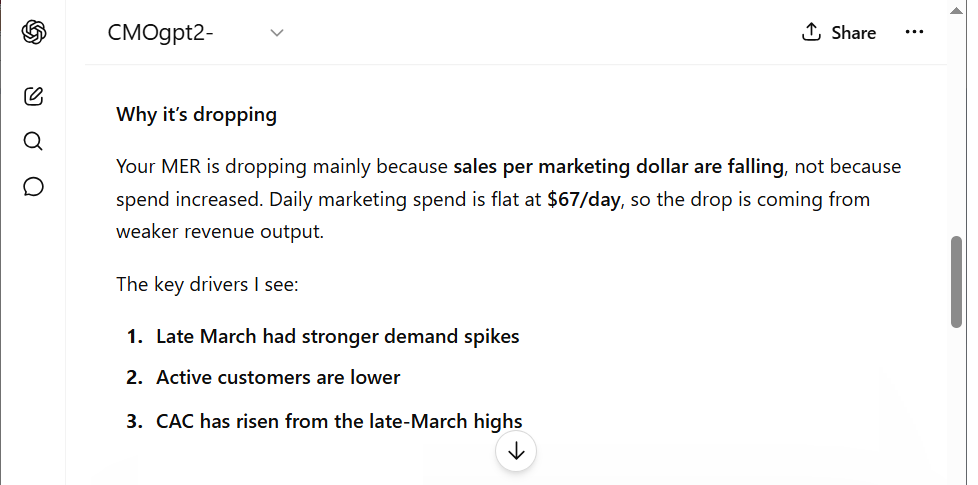
From Diagnosis to Action
CMOgpt provides an advisor that helps you understand what to do next.
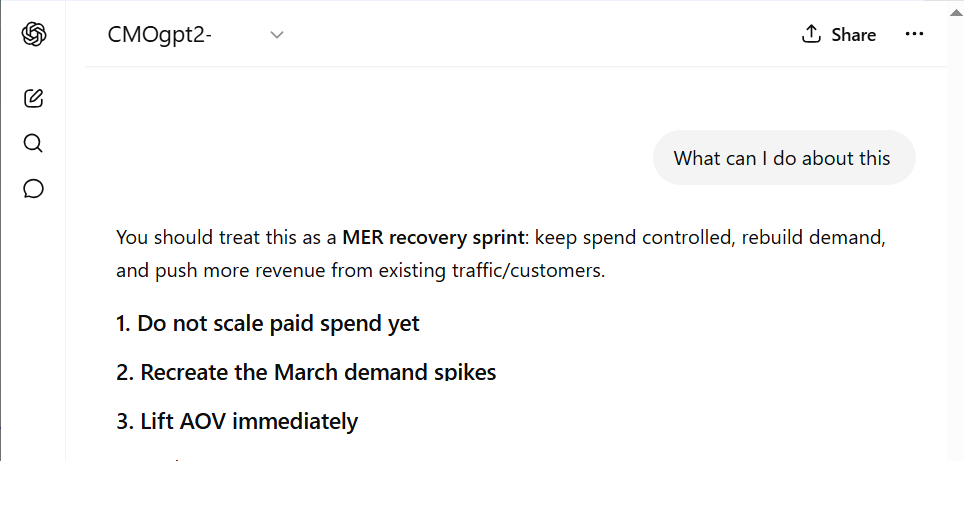
The way CMOgpt answers follows four simple steps:
Problem → Evidence/Benchmark → Likely cause → Action
All personalized to your business at this point in your growth cycle.
Final thought
ROAS is useful for managing campaigns.
MER is a tool to your business profitability.
Your business is unique. Your margins are unique. Your customer mix is unique.
CMOgpt helps you turn your Shopify and GA4 data into clear answers, diagnoses, and practical advice on what to do next.
Try CMOgpt and ask your AI CMO:
Is my growth actually profitable, and can I afford to spend more on ads?
About the author :
Andrew is a fractional CMO to DTC brands, and former owner of a digital marketing agency. After years of building marketing analytics platforms, running digital campaigns, and advising businesses on growth, Andrew created CMOgpt.io to help ecommerce founders turn complex data into clear decisions. CMOgpt.io combines AI, ecommerce metrics, and real business experience to help founders understand their numbers, find profit leaks, and grow more profitably.
Comments